The ideal faucet
Designing the ideal faucet using thermostatic valves

How about a little break from AI? :) Let's talk about faucets.
Problem
Faucets have a terrible UX for something we use 50 times per day, according to Wikipedia. I have exactly two use cases for a bathroom faucet:
- Wash my hands
- Fill a cup with water
And yet, with a typical two-handle faucet, I have to manually set the temperature every time and wait for it to adjust. I don't need or want a full range of temperatures or to be impacted by variable-temperature water mains.
Solution
We want the most user-friendly design that achieves the following:
- 2 set temperatures - comfortable warm (e.g. 100°F) or drinking cold (e.g. 55°F)
- Possible to configure set temperatures
- Possible to control water flow
The ideal faucet achieves this with one simple handle with one degree of freedom. Pull the lever toward you for warm water. Push it away for cold drinking water. Set the two temperatures using control knobs under the sink. You can play with it below:
Under the sink
The sink handle drives the position of a plunger in a spool valve with 3 ranges. The center range (±4° rotation) blocks the flow of warm or cold water. The ranges on either side (±38° rotation) allow for a variable amount of warm or cold water, respectively, to flow from separate fixed-temperature channels.
How we do condition water for a fixed temperature? The magic boxes labeled "TMV" are thermostatic valves. They output a fixed water temperature given variable-temperature hot and cold supply lines. We'll look at how those work next.
Here's the full system diagram. Drag the temperature slider at the bottom to control it:
Thermostatic valves
Thermostatic mixing valves are relatively common in commercial plumbing - you've probably used one in an airport or hospital - but extremely rare in residential bathrooms. Mechanical variants work using a wax element which expands or contracts based on the water temperature in a mixing chamber fed by the hot and cold lines, causing a shuttle to move which re-adjusts the proportionate mix until equilibrium is achieved. This is how our warm and cold lines can hold a set-point against a hot main that swings twenty degrees or a cold line robbed of pressure by a flushing toilet.
Below you can see how this works by disturbing the inputs (set-point and supply line temperatures) to watch the system re-achieve equilibrium. The time constant of the wax element is ~1s.
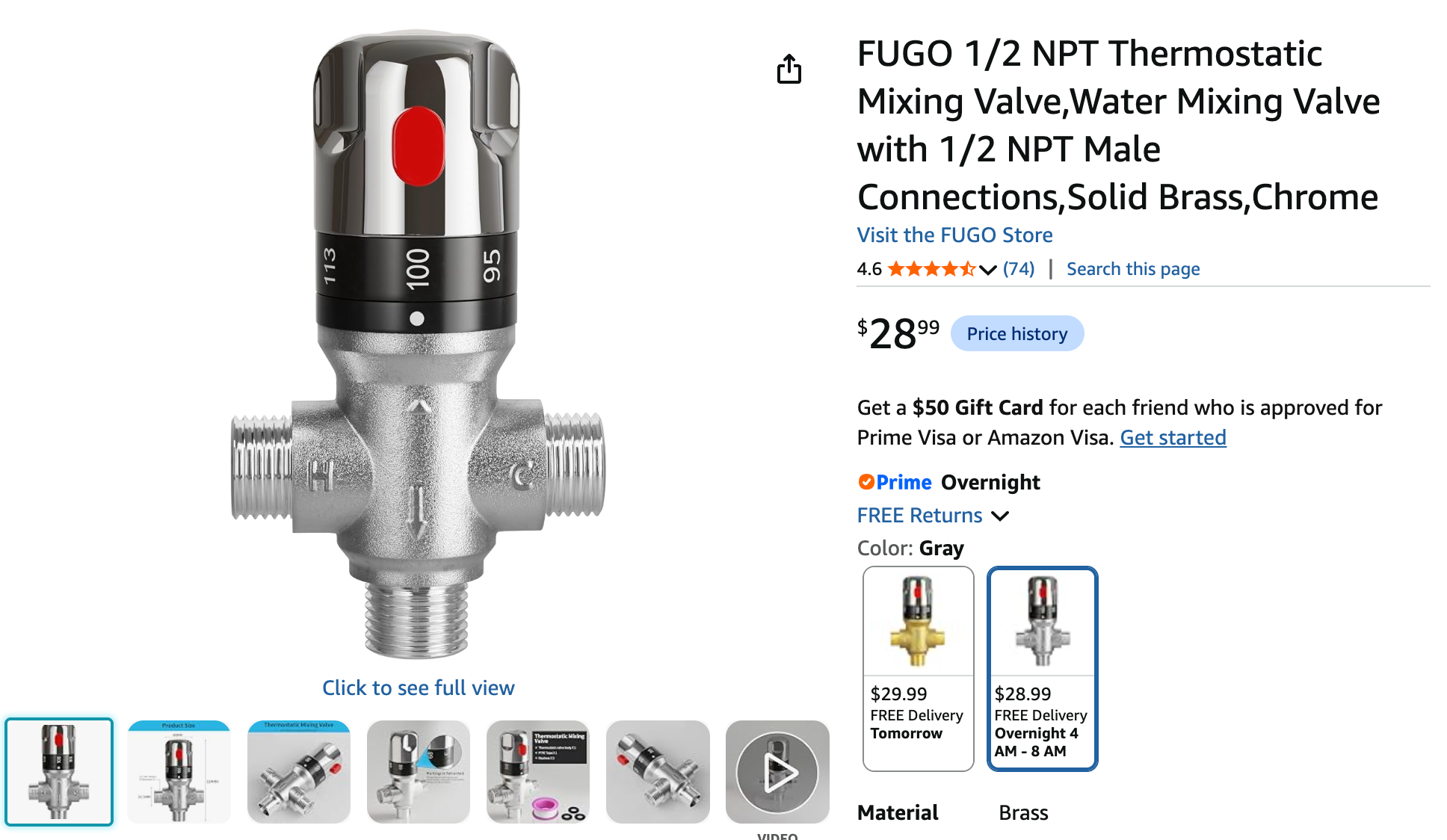
Thermostatic valves I found on Amazon range in size and set point design - most of them have simple set screws - but this one had a nice Farenheit adjustment knob:
Caveats & notes
- Thermostatic valves don't work at low water flow. ASSE 1070 rates most of them down to 0.5 gpm. This faucet's handle does not reach 0.5 gpm until 23° of its 38°, so the first 61% of the travel - a rinse, wetting a toothbrush, etc - is flowing less than the valve can hold. Low-flow valves buy us another ~20% of handle travel, but to achieve the full range, a different solution, probably an electrically-conditioned water reservoir, is required.
- Dead-leg design means changing temperature isn't instant. Liquid between the spool and the aerator - roughly three fluid ounces - is left over from the last use. So, push for a cold drink after washing your hands and the first water out will be warm. No valve arrangement fixes this, only a shorter riser or a recirculating loop does.
- Disruptions like proximate toilet flushes are noticeable. The wax element's 1s time constant means a few seconds of temperature change up to ±10°F from the set point. Only way to avoid this would be a redesigned thermostatic valve or the pre-conditioned reservoir mentioned above.
- More parts. This design requires roughly triple the parts of standard two-handle-vanity mixing cartridge plumbing.
- Stock valves don't work at low temperatures. While a thermostatic valve is conceptually the right idea, no stock valve supports a set-point below 80°F. A custom, low-range element would be required or an electric system as discussed above. Or, the system could use the cold main directly when in cold mode.
- Nobody makes this spool valve component. Bidirectional proportional spools are ordinary in hydraulics and unheard of in faucets. It might be possible to build one from a stock 3-way proportional valve and a machined lever, otherwise it would have to be custom-made.
Conclusion
Many years in the future, we will look back at faucets today and wonder why we put up with poor UX for so long. If you're interested in this problem, reach out! Maybe we can start a movement.